
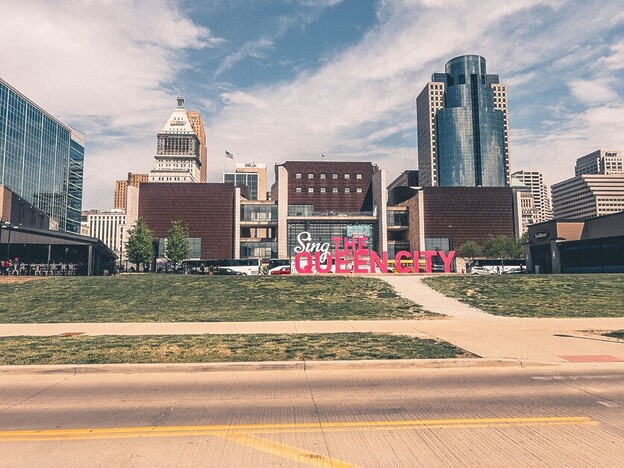
Helen Johnston offers up her personal guide to the Queen city of Cincinnati.
It’s probably fair to say that Cincinnati wouldn’t be on everyone’s top ten list of US cities to visit, and a lot of British people probably wouldn’t even be able to pinpoint it on a map. And that included me before I had the opportunity to go there.
While the rest of the world sometimes remains a mystery to many American mid-Westerners, the mid-West remains a mystery to many of us. Brits who think they know America because they’ve visited Florida or New York should note that big chunks of the middle of the country are entirely different.
So where exactly is Cincinnati, or Cincy as it’s called locally? Well, it’s in Ohio, west of New York and south of Chicago, if that helps, and it falls within Eastern Standard Time, which is five hours behind the UK. It’s also right on the borders with Kentucky and Indiana so would be perfect as a launchpad for a three-state tour. My trip was primarily to Cincy, although I did get across into Kentucky thanks to a riverboat cruise.
River Border
The Ohio River forms a natural state border between Ohio and Kentucky, and it’s on the latter’s side that BB Riverboats’ cruises launch. The river enabled Cincinnati to become a major trading hub in the early 19th century when its rapid growth and wealth earned it the nickname of Queen City.
The water level was high the day we went on a cruise so the smokestacks on top of the boat had to be lowered to enable it to get under all of the seven bridges spanning this stretch of the river. The boats are driven by diesel engines now, but they still have the smokestacks and a paddle on the back to give them the traditional riverboat appearance. They are also given traditional names and ours was the River Queen.
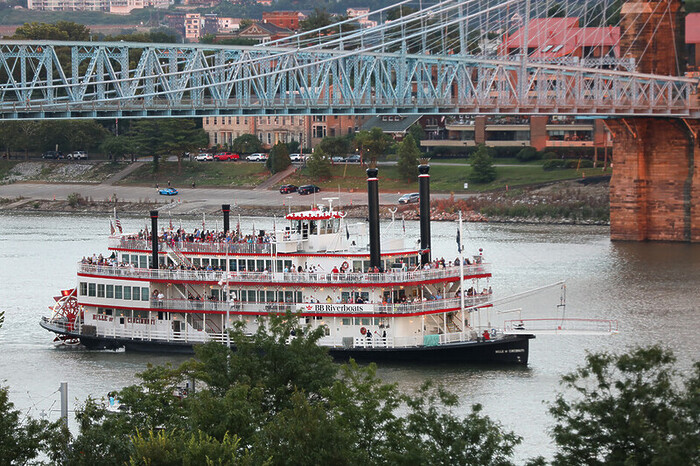
We went on the Captain’s Lunch cruise which included a decent hot buffet dinner, giving a choice of meat, vegetables and salad, followed by cheesecake for dessert. The cruise was two hours and we were able to walk about the boat and stand outside on deck watching the scenery flow by. Inside we were treated to a banjo player who also gave us a history of the river and the notable sights we passed along the way.
He got the crew up dancing for a rendition of Sweet Caroline and encouraged passengers to singalong to various ditties including You Are My Sunshine which, as he confidently predicted, everyone knew.
One of the bridges featuring two stone towers reminded me immediately of Tower Bridge in London. This one was designed by John A. Roebling, after whom it is named. When it opened in 1867 it was the longest suspension bridge in the world but was overtaken in 1883 by another of Roebling’s designs, the Brooklyn Bridge in New York.
The Ohio River was used as a crossing point for slaves escaping Kentucky, where slavery remained legal until 1865. Ohio banned it in 1802, shortly before joining the Union in 1803. Many escapees who crossed the river then continued to travel north, some even going to Canada.
Escaping To Freedom
The Roebling bridge is directly in front of the National Underground Railroad Freedom Center (NURFC) which tells the moving stories of some of those enslaved people who made the perilous journey to a new life. The ‘railroad’ had nothing to do with trains, it was a secret network of abolitionists (often called conductors), safe houses, and escape routes.
Ohio had 3,000 miles of escape routes along the river so was prominent in helping slaves to freedom. The NURFC says the best estimate of how many people escaped via the railroad is 100,000. One of the most incredible escape stories comes from another part of the country when Henry “Box” Brown had himself nailed into a small box and shipped from Virginia to Philadelphia. A replica of the crate is on display and looks impossibly small to hold a man.
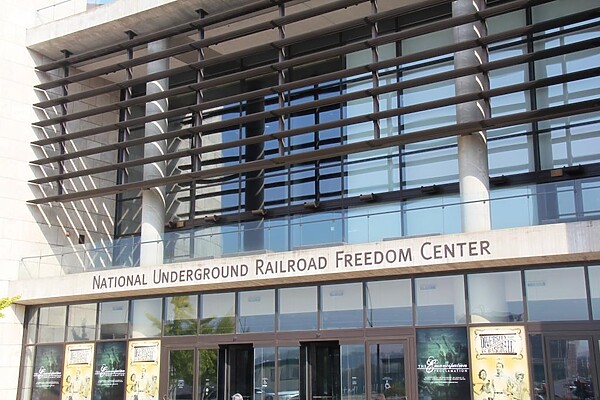
The centre doesn’t just focus on slavery it also acknowledges the Native Americans who were forced from their lands. Ohio was previously home to the Miami and Shawnee nations and so this area’s history is very much bound up in America’s divisions and transformations. There is also a thought-provoking display about present day human trafficking and slavery, definitions of which vary.
It notes that it is difficult to put a number on how many people in the world are enslaved today because many governments don’t collect data on it, so figures range from 12 million to 27 million. Slavery has also become cheaper over the centuries, the average cost of an enslaved person down from the equivalent of $40,000 in 1809 to $90 today. One exhibit gives visitors the chance to understand how trafficking is going on in Ohio today and what can be done to help.
An eternal flame burns on an outdoor terrace on the third floor, just as candles once burned in the windows of safe houses, and is a permanent memorial to victims of slavery.
There is a wooden slave pen from 1830 on display, a place of abject misery where up to 60 enslaved men, women and children were held until being sold. A museum notice asks visitors to be quiet and respectful and observe the structure as a memorial to the people who were held in it and the tragedy of enslavement. The NURFC is one of the most powerful and engrossing museums I have visited and, although it exposes some uncomfortable truths, it has consistently made the top ten of American museums voted for by USA Today readers and was number one in 2023.
Art And Tea
For art history lovers the Taft Museum of Art is also worth a visit and offers free entry on Sundays and Mondays. It is named after Charles Phelps Taft, half-brother of the 27th American president William Howard Taft, and a politician in his own right, as well as being a lawyer and newspaper publisher.
The museum is in the house which Charles Taft lived in with his wife Anna Sinton who inherited a large sum of money from her father in 1900 enabling the couple to start collecting art. In 1927 they bequeathed their home and its 530-strong art collection to the people of Cincinnati and the museum opened in 1930. It’s a beautiful home and a beautiful collection of pictures and other artifacts.
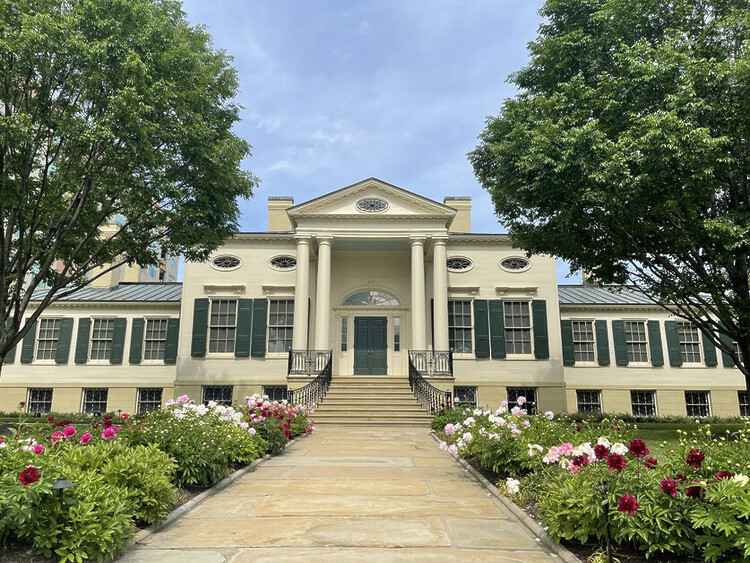
On the day I visited there was conservation work underway in the main entrance hall to uncover landscape murals painted by pioneering 19th century black artist Robert S. Duncanson who achieved international acclaim for his work. The museum’s art collection has now expanded to more than 800 pieces including work by British artists like Gainsborough and Turner.
Another nod to Britishness can be found at Findlay Market where Churchill Teas provides a temple for tea lovers with shelves including flavours such as Christmas Carol in London, Creamy Earl Grey, Yorkshire Harrogate, and Scottish Breakfast. I’ve never seen so many different teas in one place before. It’s a pity so many Americans still don’t have the knack for making it properly. Findlay Market opened in 1855 on land donated by a previous mayor of Cincinnati, General James Findlay, and is the oldest continuously run market in Ohio.
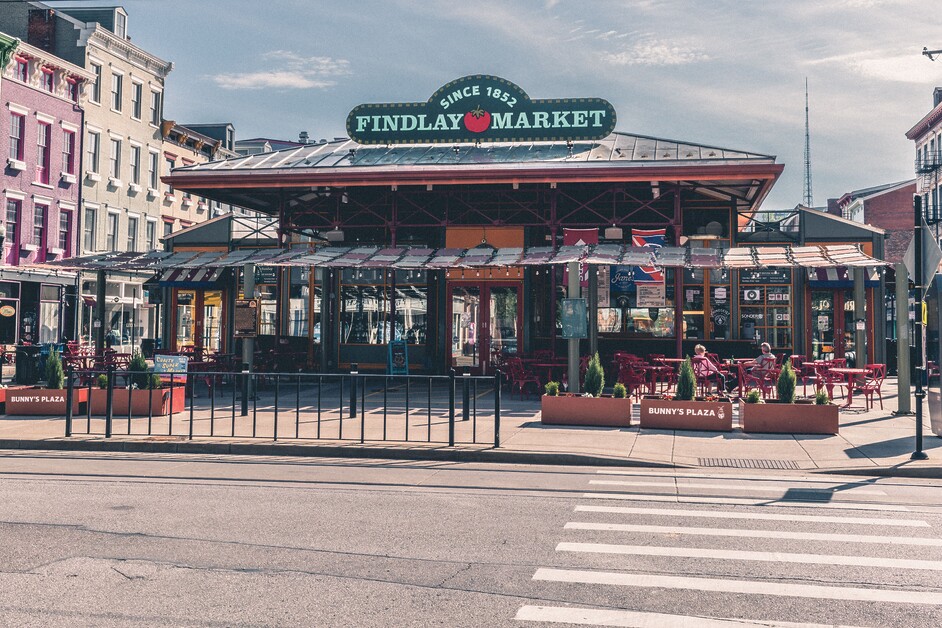
It’s in the historic neighbourhood called Over The Rhine because of the German immigrants who first settled in the city. The indoor market has a good range of stalls selling everything from meat rubs (blends of spices and herbs) with names like Butt Rub and Cowgirl Rub, to sweetcorn ice cream. I tried this and it tasted just like vanilla with bits of yellow in it.
I visited on a Tuesday when the market was quiet and the area around it seemed like it needed revitalising. Several shops had signs on the door saying they were closed on Tuesdays and several were empty. I walked along to Washington Park which is lovely with dancing fountains, a bandstand and colourful flower beds. It is close to the first English Lutheran Church dating back to 1842 but that was closed too so I walked back to the market. This was a neighbourhood of contrasts, the posh teas and artisan food outlets seeming at odds with some down-at-heel streets. Perhaps it’s livelier at the weekends when the outdoor market is on.
Home Of The Reds
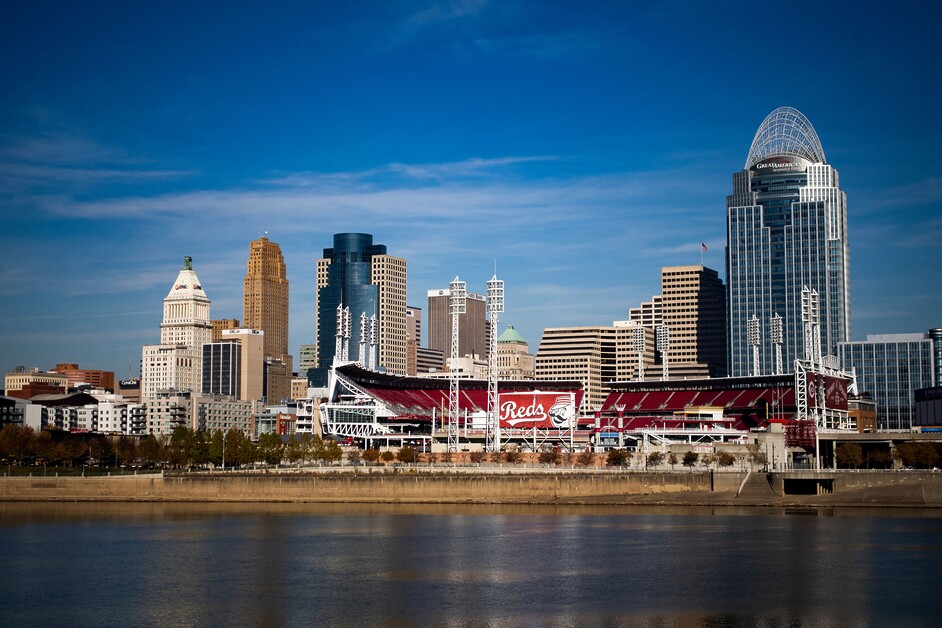
One place which was lively was the Great American Ballpark, home of the Cincinnati Reds baseball team. Fans were streaming into it on the night we went to watch the Reds play the St Louis Cardinals and there was a sense of camaraderie and anticipation. It’s a huge stadium so was by no means full, but there were enough spectators to create an atmosphere, especially when the kiss cam was in operation.
In fact, the camera’s movements were followed more closely than the players’ actions, and many people seemed more invested in their hot dogs and fries than they were in the scoreline. Our seats high up in the stands gave us a great view of the Ohio River just beyond the stadium, which was a bonus when the action on the pitch was slow.
Cincinnati is easy enough to get around but I found it difficult to pinpoint a ‘city centre’ of shops in the same way that British cities have them. There are plenty of buses and an app called Transit gives instructions on how to get somewhere by telling you which stop to go to, which number bus to get on, and when it will arrive. I was staying out in the suburbs where the car is king and buses are few so the app was handy for working out timings, especially when there can be some distance to walk to a stop.
Out of town retail parks with their huge car parks are popular and there was a good selection of shops and eating places in the Madeira area where I was. It was quite shocking to see a sign in one mall warning that firearms were prohibited. Who wants to go shopping carrying a gun? It was a stark reminder of America’s relationship with arms.
International Food Shopping
On a lighter shopping note, a ginormous supermarket called Jungle Jim’s is worth a visit, if only to gawp at the myriad number of items on sale from around the world. This international market is the size of six football fields and like no other food store I’ve ever been in. It stocks more than 180,000 items, including 4,000 varieties of beer and food from 75 countries. The Great Britain aisle has a model of Robin Hood and features such staples as baked beans, HP sauce and chocolate digestives.
There was also a singing lion called Elvis in the sweets section, and regular toilets with doors which made you think you were going into a Portaloo. Bizarre doesn’t cover it.
In terms of eating out, Cincinnati has no shortage of restaurants on offer and one of the best is Incline which sits at the top of a hill and provides amazing views of the city and river from its terrace. The pork chops are good too. The best ice cream I had was from local company Greaters at Walnut Street. It was called Midnight Snack and was a malt flavour with chocolate, pretzels and brownies thrown in. No sweetcorn in sight.
I wouldn’t make Cincy my only destination in America but it’s a good place to visit as part of a multi-city jaunt or a road trip because it provides a view of the mid-West which contrasts with other parts of the USA. It’s a mix of thought-provoking museums, baseball, Yorkshire tea and Butt Rub. There’s got to be a marketing slogan in that.
All images (C) Cincy Region
Tell Me More About Cincinnati
Find information about BB Riverboat Cruises here.
Find information about the National Underground Railroad Freedom Center
Find information about the Taft Museum of Art
Direct flights operate to Cincinnati/Northern Kentucky International Airport from London Heathrow.


