In her Insider Guide to Elche, Liz Gill explores what this fascinating city offers for both body and soul.
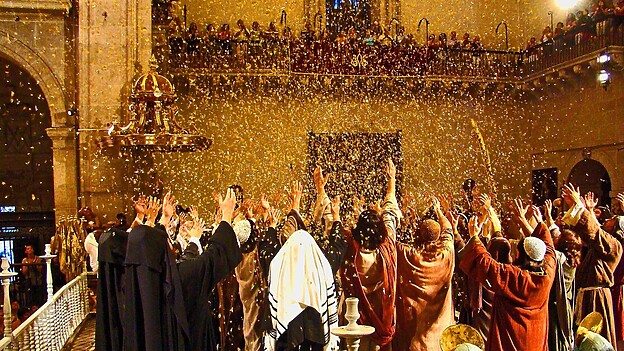
Eighty feet above us in a cloud covered canopy, the doors of heaven open and through them descends a huge lavishly decorated red sphere which slowly opens to reveal eight golden segments. At their heart is a boy dressed as angel in a sky-blue robe with white wings. Bells ring, the organ sounds and the boy releases a shower of gold paper. And then he begins to sing, his heart-rending treble voice soaring out over the hushed thousand-strong crowd below. It is a spectacular moment worthy of any West End show.
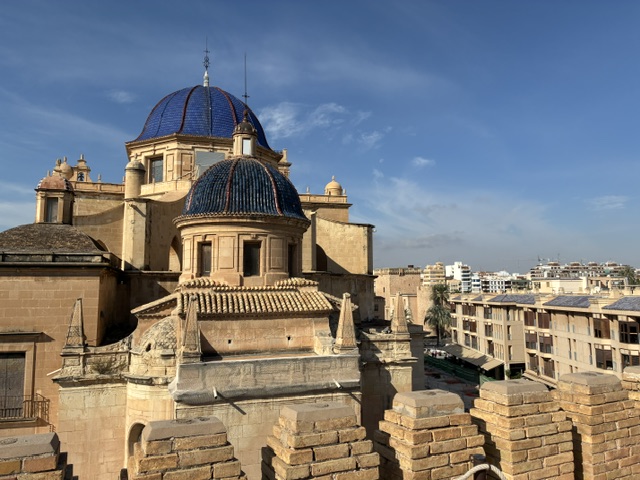
But this is not a theatre. It is the Basilica of Santa Maria and what we are watching is the 500 year-old Misteri d’Elx, one of the oldest continuously performed mystery plays in the world, which tells the story of the Assumption of the Virgin Mary and her coronation as Queen of Heaven.
That it still exists is due to the perseverance of the people of Elche – Elx in the old Valenciano language – who, after the Council of Trent banned performances inside churches, petitioned the Vatican for theirs to be an exception. The result was a Papal Bull from Pope Urban VIII granting their request in perpetuity.
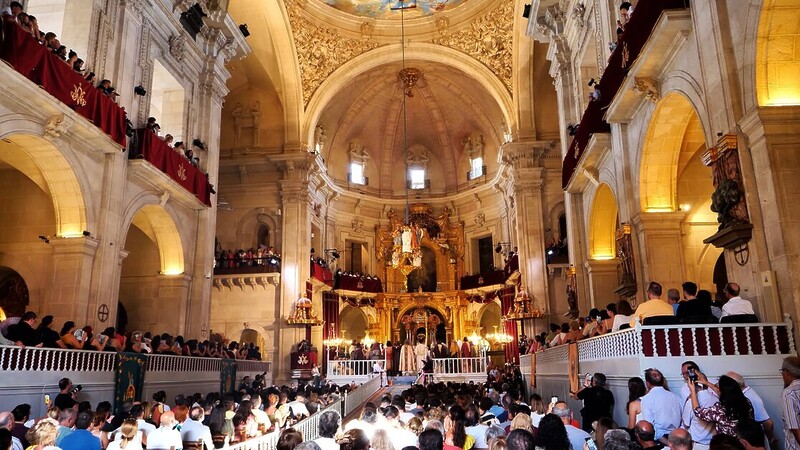
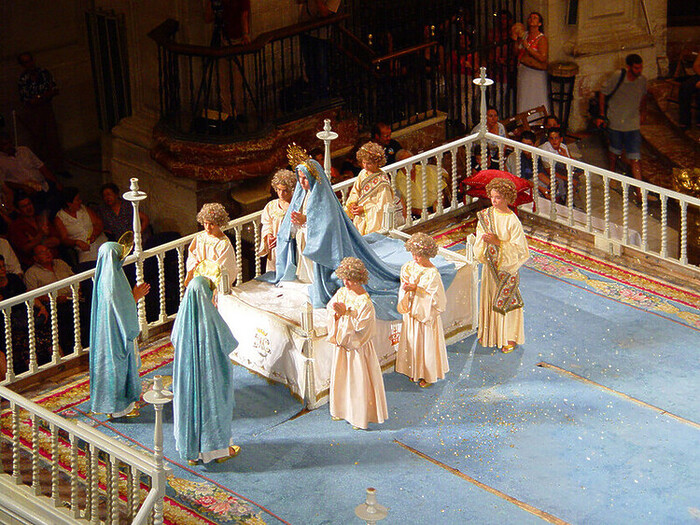
Although the baroque basilica is the third church on the site, the traditions of the play remain unchanged. So Mary and her supporters Mary Salome and Mary Jacobi are played by boys: medieval customs forbade the participation of women. It is all sung a cappella by a range of men’s voices; there isn’t a single microphone but so brilliant are the acoustics that every word can be heard.
It opens with the arrival of Mary and her entourage at the great rear door who progress along the aisle to a specially constructed stage near the high altar. They are followed by the Apostles and later by a group of Jews who attempt to steal the Virgin’s body.
A fight ensures, the gang leader is struck with paralysis and he and his followers are converted.
There are more ascents and descents culminating in the climax when God the Father flanked by the Son and the Holy Spirit comes down to crown the Virgin to thunderous organ chords, wild applause and cheering and even more glitter.
The play is performed every year in two parts on August 14th and 15th. These are free but the queues are long and it is possible to buy tickets for rehearsals – a combined shorter version of the two parts – on previous days. In even numbered years it is also performed at the end of October and beginning of November which is when I went to a ticketed performance.
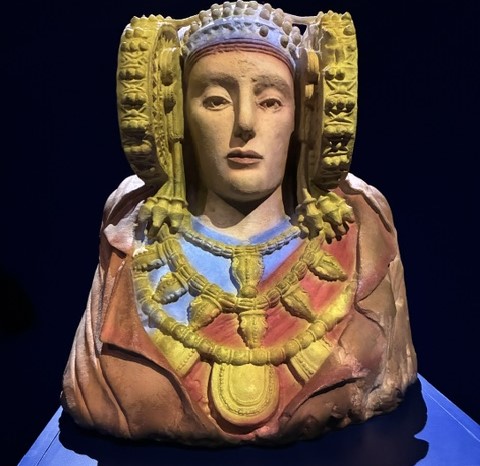
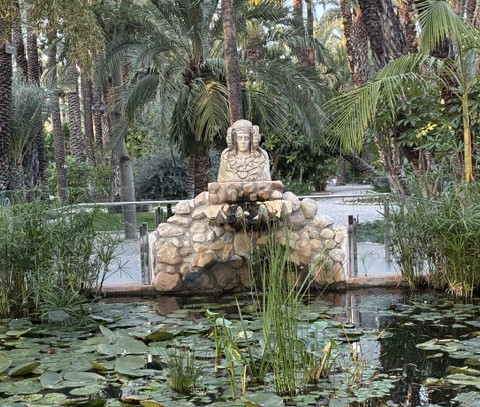
Visitors who can’t catch the actual performance can learn all about it and watch videos in the Museum of the Virgin of the Assumption but even without the play Elche has much to offer. It has, for example, another very famous lady the Dama de Elche, a 22 inch limestone bust from between the 4th and 5th centuries BC which was discovered in farmland in 1897.
She has beautiful features, splendid garments and jewels and an elaborate headdress with coils around her ears which some claim inspired George Lucas to create Princess Leia’s look in Star Wars. Although the original is in Madrid the Dama’s image is everywhere from inside snow globes to the coloured replica in the Archaeological and History Museum in the refurbished Altamira palace. Nobody, however, knows her original purpose or her role. Was she a goddess or a royal? The only clue is the discovery of human ashes in a hole in her back suggesting she might have been used in funeral rites.
Although Elche has had Roman and Iberian eras the current site was created by Moors in the 9th and 10th centuries – parts of the walled city and one of its defensive towers can still be seen – who also devised an elaborate irrigation system to water the palms they had planted as an oasis.
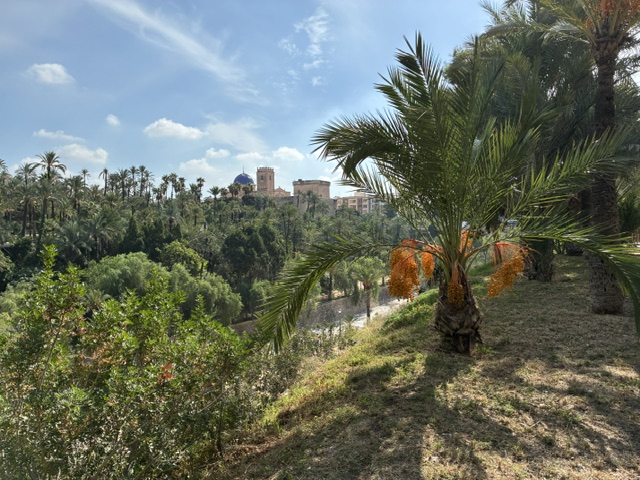
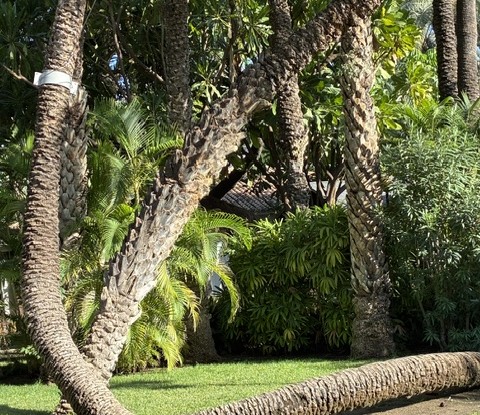
The Moors were driven out in 1265 by King James I of Spain but the palms remained – and thrived. Today there are 200,000 of them, almost one per person for the 240,000 residents, making the palmeral or palm grove the largest in Europe. There is even a trail highlighting 17 that are of particular note because of their beauty or their shapes – examples include the cobra, the catapult, the candelabra– or their history.
One that I saw in the Huerto del Cura, for instance, was named the Imperial after Empress Elisabeth of Austria expressed her admiration during a visit for its seven branches from one stem.
A more up to date source of admiration came from watching Miguel Sanchez a palmerero or palm gardener demonstrate his skill in climbing one to harvest its dates. He can average 120 lbs a day. How fast could he move, I asked. “The fastest was for a competition where I climbed about 11 metres in 11 seconds,” he says. “But I wasn’t even the fastest. I was third.”
Another palm related local skill is in creating white palm ‘sculptures’ for Palm Sunday when thousands of onlookers wave them as the procession passes through the streets. The whiteness is created by wrapping the branches for up to a year so that they cannot produce green chlorophyll. The result is then woven in workshops to produce both simple and highly ornate creations. The tradition goes back centuries with techniques passed from generation to generation.
There is though plenty for the body as well as the soul in Elche. Dates are, of course, a key component. They are only produced, I learn, by female bushes – the palm is a bush not a tree – and when harvested between October and April are often eaten fresh. A component of breads, biscuits and cakes, of a wine and a liqueur, they are also the basis of a local appetiser the where one is stuffed with an olive, wrapped in bacon and fried.
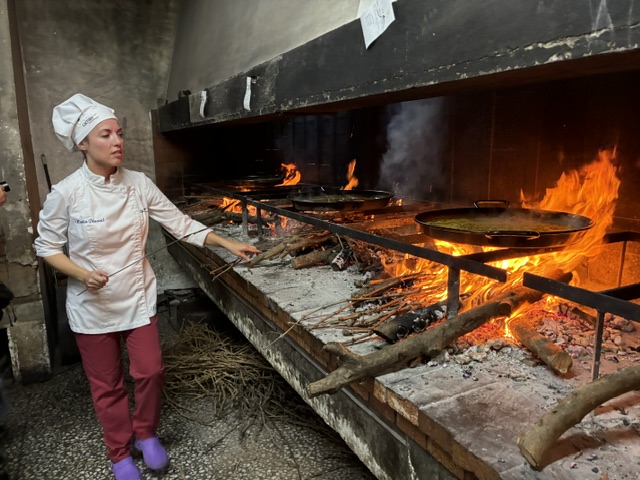
Rice is another key ingredient. The star turn is arroz con costra where rice and typically chicken, rabbit and sausages are cooked over a vine and olive wood fire until the rice is almost done. Beaten eggs are then poured over and covered with a costrera, a special metal lid, into which are poured hot embers so that the eggs emulsify and form a crust.
Noelia Pasqual who is the fourth female member of her family to run the Cachito restaurant since it was founded by her great grandmother, demonstrates the technique as I marvel how someone so slender and glamorous can wield such heavy equipment in extreme heat. Earlier she had taken me into the garden to show me the small sweet pepper the nora which when dried and combined with dried cod, oil and garlic makes the delicious starter pipes i carasses.
The night before I enjoyed a meal of other local dishes including a soupier rice dish with seafood and the interesting experience of trying out the Elche way of eating boquerones or marinated anchovies: you squash them between large potato crisps to make a mini sandwich.
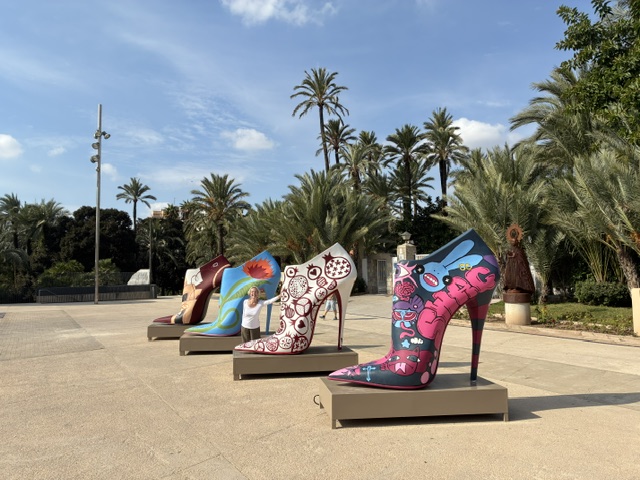
The city is ideal for a short break but longer stays can include visits to the wider Elche region with its wetlands, sand dunes, pine forests and five miles of beaches. Those who want more culture can visit the Traditional Culture Centre at the Pusol School Museum which along with the play and the palm grove also has a UNESCO designation; Elche is one of the few places in the world to have three such awards. It is also the footwear capital of Spain so shoe lovers might want to look for bargains in its factory outlets.
Play images (C) Gloria Patri.
Tell me more about this Insider Guide to Elche.
For more information on the city please go to Visit Elche
A night at the Huerto del Cura Hotel costs around £125 for a room with breakfast
The meal I had at El Graniano costs £44 with wine and at Cachito £35 with wine.
There are plenty of flights to Elche-Alicante International Airport.