
Anthea Gerrie Visits Hotel Elephant, Which Made Weimar Famous Before The Bauhaus Put The German City On The Tourist Map
When a city is famous for as many reasons as Weimar, it’s quite something for its best hotel to be famous in its own right. But the exquisite Hotel Elephant was born long before native sons Goethe and Schiller, before the revolutionary Bauhaus movement which started here had even been dreamt up, and in its transformation from 17th century inn to art deco palace has become one of Germany’s most elegant and iconic hotels.
It all began in 1696, when the Elephant Tavern opened on Weimar’s Market Square, the most beautiful in town and reason enough to consider a perch in the city’s prime location. By the time Goethe and Schiller arrived a century later it had new owners and was being recommended as the best place in town to stay.
Famous visitors included Franz Liszt, Hans Christian Andersen and the founding fathers of the Bauhaus School, the best reason to visit Weimar today, the worst being Adolf Hitler, who dismantled the hopeful new republic which was established here and signed the hotel’s 1926 guest book.
Within a decade the Nazi leader had changed everything, including the Elephant, which suffered a politically motivated demolition in order to make way for what Hitler decreed must become “the most modern hotel in Europe, forward-looking in terms of furnishings and architecture.” That would have meant a Modernist Bauhaus building, had the Nazis not closed the school down as subversive; instead, the hotel reopened in 1938 as the neoclassical Haus Elephant.
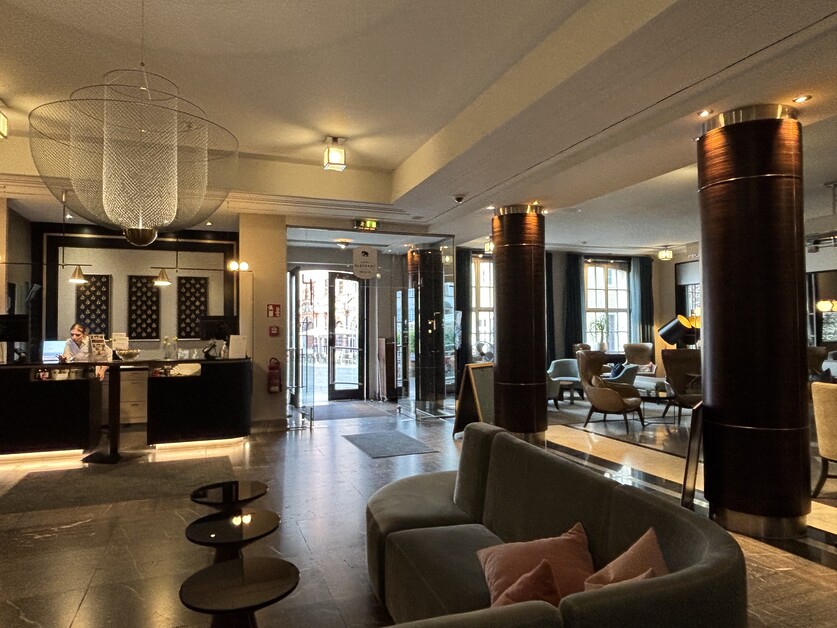
Today’s gorgeous hotel, with its wealth of bevelled glass, black and silver accents, is the result of a later, more elegant and user-friendly renovation, though the interior looks as though it has been in place for a century.
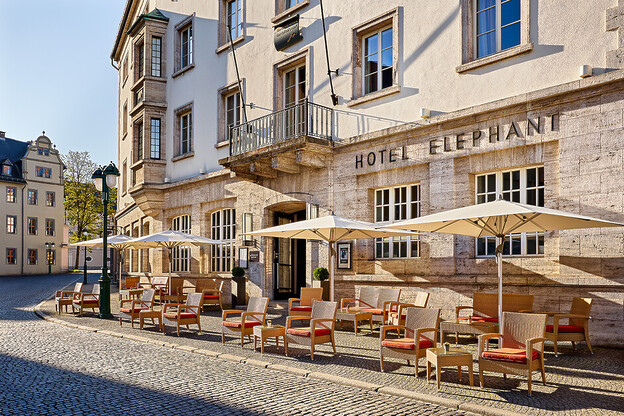
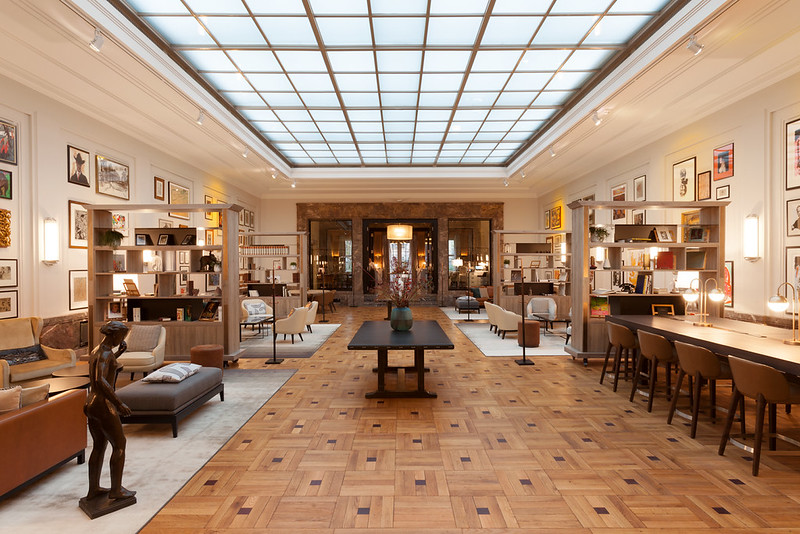
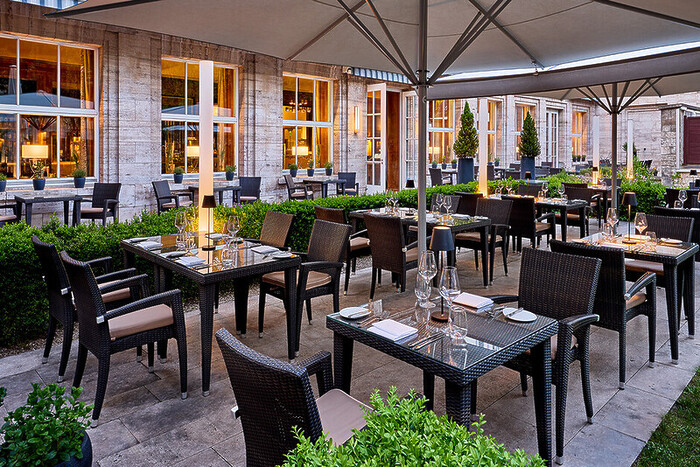
The golden stone facade with its terrace tables overlooking a beautiful cobblestone square packed with stalls by day and cafes by night would look at home in the Cotswolds, but it’s all Mitteleueropean grandeur once you step into the elegant lobby. A corridor lined with display cabinets showcasing covetable collectibles leads to a spacious lounge and beyond it a fine indoor-outdoor restaurant where alfresco breakfast and dinner is a special joy of summer months.
The hotel is distinguished by an especially fine wine list, a good place to learn about the best drops produced in Germany.
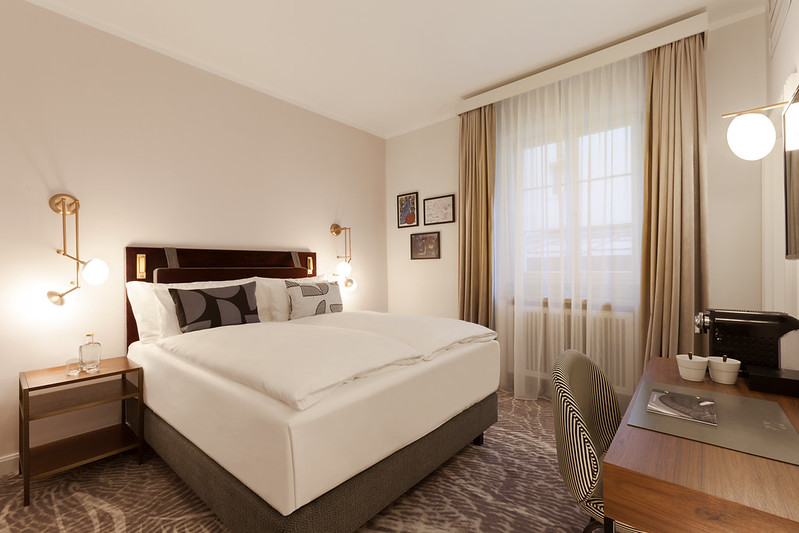
Spacious elevator lobbies on the room floors studded with sculptures lead to surprisingly plain rooms; simplicity and monochrome are the watchwords for the decor, although comfort is never sacrificed and bedding, in particular, is lavish. A room overlooking the front would be a plus if available, but with so much to see in Weimar we spent little time in our side-view room apart from recovering from sightseeing, enjoying the luxurious bathing facilities and sleeping deeply.
The original Bauhaus school which aimed to create a better way to live after World War I – letting in more light and equating good architecture with a high level of craftsmanship – is open, easy to walk to from the town centre and free to visit, though the school was forced to move from the campus, its principles considered politically incorrect, after only a few short years.
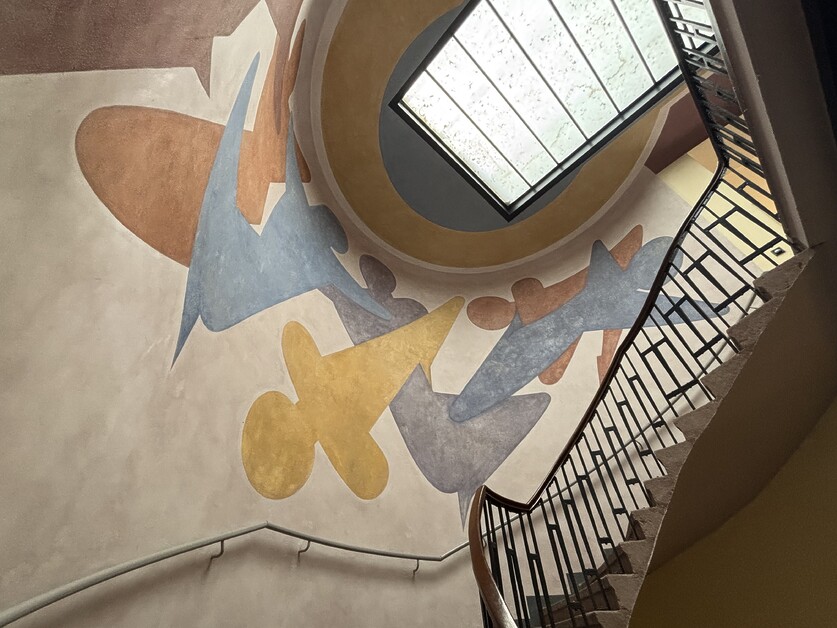
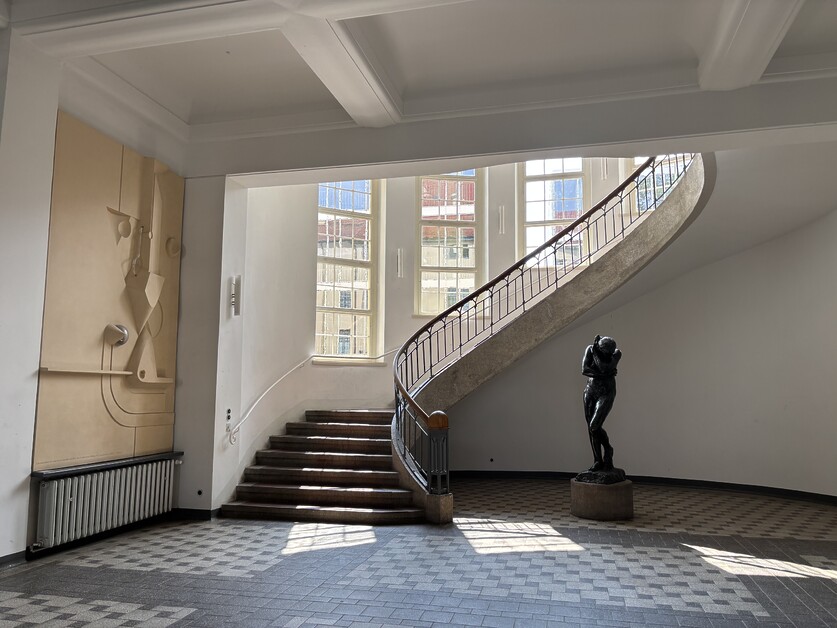
The impressive main building, with a Rodin statue in the lobby standing at right angles to a relief which is the essence of Modernism, is but the first intriguing sight for art lovers, who should not miss artist Oskar Schlemmer’s fabulous staircase murals in the building of applied arts opposite.
Here students spent their mornings working with wood, metal and other materials before crossing the path for lectures by artists including 20th century greats Wassily Kandinsky and Paul Klee.
Treasures produced at the school are held across town in the distinctly unlovely white cube of a Bauhaus Museum built to commemorate the school’s 2019 centenary, but its exhibits are priceless and not to be missed, particularly the chairs which were blueprints for the best and most beautiful we use today. It’s shocking but perhaps not intentional that the window of the top-floor room frames the memorial at Buchenwald concentration camp, where one Bauhaus student survived Nazi persecution by helping design his own prison camp.
Happier sights include the Haus Am Horn, the only Bauhaus-designed home ever to be built in Weimar, which shocked at the time with its open plan family room replacing the traditional front parlour, Europe’s first fitted kitchen and a bathroom with hot running water. The house is on one side of a beautiful central park spanning the city which also contains Goethe’s Garden House.
Do leave time to wander the cobbled streets and people-watch in many charming cafes connecting a series of squares, boulevards and lanes which make the city so strollable. Weimar, the original seat of the German Republic, may no longer be a political capital, but it has never lost its cultural capital or the considerable charms which make it a fine choice for a long weekend within a train ride of Berlin or Leipzig.
Tell Me More About Visiting The Hotel Elephant in Weimar
Hotel Elephant, Markt 19, 99423 Weimar, Germany
T: +49 3643 8020
Rooms from €220
If you enjoyed this review, why not check out these similar posts:
 Touring Elephant Centres in Thailand. Discover the best for elephant welfare.
 The Swan Hotel and Spa. Discover this historical icon in lovely Lavenham
 Anantara Marker Hotel. Discover a 5-star Dublin Icon with a fabulous facelift.
 Le Majestic Barriere. A Cannes Icon reopens in March following a glorious face lift.


