
In his Insider Guide to Hiroshima, James Ruddy spends 72 hours exploring its food, islands ancient Inns and baths.
A little boy was protesting in his pushchair, but his pink-suited baby sister remained sleepily untroubled. Dangling from her mother’s chest harness, bare toes wobbling, she slept through the busy morning commute. Mum gave me a shy smile as she passed.
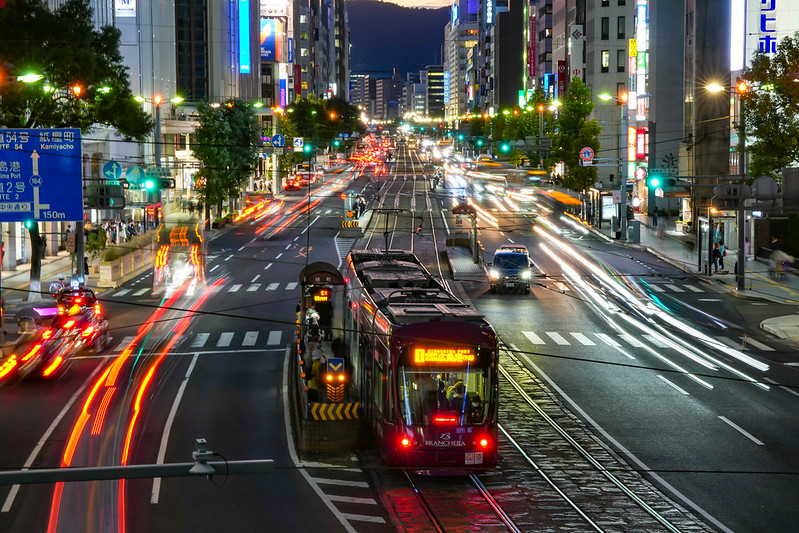
Nearby, schoolgirls in smart blue uniforms, pedalled toward their classrooms, as helmeted workmen joked while hauling scaffolding into another new skyrise building site. A bearded old man passed with a guitar. At the road crossing, everyone waited for the green light and its accompanying birdsong. Hiroshima was waking up to another day.
I had arrived expecting its unenviable past to dominate everything. Instead, my first impressions were of ordinary life and a remarkable free-and-easy present: river walks, inviting bars and a restaurants, busy shops and children playing baseball in the park. Over three days, the city and its neighbouring islands revealed a destination with enough variety to satisfy food lovers, cyclists, families and travellers who prefer a gently paced adventure.
For Europeans, this was a long weekend best included in a longer Japanese holiday (as I had done first with an 8-day Walk Japan trek round the remote and mystical San’in region). The flights alone make a Friday-to-Monday dash unrealistic. But giving Hiroshima three days within that journey and it delivers something quite extraordinary, with the favourable yen helping my money to stretch.
Atomic Bomb Dome
My first night base was the four-star and centrally positioned Hotel Granvia, where I met my guide Nagi Nakayama, who took me by the Hiroden tram to the Atomic Bomb Dome. The tram itself was an appropriate beginning: incredibly, its service was partially resumed just three days after the bombing, an extraordinary early act of recovery by the still-burning city.
As we rolled along into the centre in a carriage occupied by an excited crowd of mostly North American and European tourists it was hard to imagine that this was the place where the first atomic bomb dropped in a war had burst in a huge flash at 8.15am on August 6th, 1945. Instantly, its core temperature had risen to millions of degrees, as 60,000 buildings were wiped out, as were one third of the population, by heat, blast and that new scientific scourge, radiation.
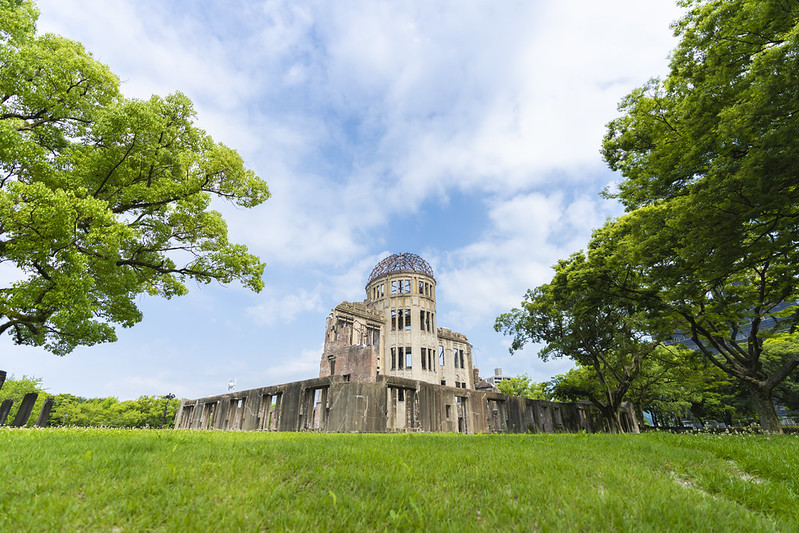
As we stepped off the tram, I headed toward that internationally recognised remnant of the devastation, the skeletal framework of the Dome, which withstood the impact. Around it, the modern city carries on its busy life, while the nearby rivers and paths of the Peace Memorial Park provide the space to pause and reflect.
Nagi’s family history made that reflection truly personal. She told me how her grandparents survived outside the central devastation. The family restaurant became a place to receive and care for injured people. She also explained how difficult remembering can be and how much it takes for survivors to share their experiences, even more than eight decades later.
Children’s Peace Monument
As we reached the Children’s Peace Monument, bright paper cranes brought another individual story into focus. Sadako Saqsaki survived the initial bombing as a small child but died later of leukaemia. Her origami crane-folding inspired a worldwide expression of hope which continues in the colourful offerings that arrive here regularly.
Inside the nearby Peace Memorial Museum, I felt I could have spent days trying to absorb the reality of the story. Packed with small and damaged possessions, searingly emotive photographs and accounts, I was struck by the contrast of the excited noise of the tram crowd earlier with the utter silence of those shuffling though these heart-rending galleries.
Outside once again, it’s clear why nearly every building is now modern in a zone where the past literally disappeared. A short walk away, children were playing a scratch baseball game in the red and white colours of the city’s beloved Carp team (founded just four years after the bomb). Watching a match – or one involving the famed Sanfrecce Hiroshima football team – would have added extra local colour to my trip (next time, maybe?).
But lunch did just that, taking me to one of the other obsessional local pleasures, okonomiyaki. Calling it a pancake scarcely conveys the engineering involved. Batter, cabbage, noodles and a varied selection of other ingredients are layered on a hotplate, with egg helping to bind the assembly. It is substantial comfort food made with assurance and locals, like Nagi, love it. So did I.
With a name that translates into ‘grilled as you like it,’ the city’s association with this dish deepened in the hungry post-war years. Today it gives visitors a strong starting point into a cuisine that stretches from oysters and conger eel to sake and regional ramen. As they say here, come hungry and your curiosity will do the rest!
Sacred Island of Miyajima
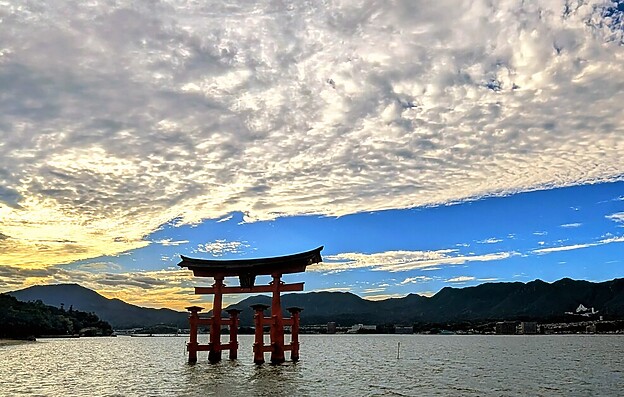
Nearby, I headed for a high-speed boat that took me from the Peace Park along a river, across the Seto Inland Sea and onto the country’s sacred island of Miyajima, famed for its giant floating red torii gate and UNESCO World Heritage Itsukushima Shrine, which draws almost 5 million visitors a year.
As I stepped ashore, hundreds of travellers had gathered around that great vermillion torii, apparently floating when the tide rose around it – yet protruding skyward from the exposed seabed when the sea rolls out again. It’s an image that has portrayed modern Japan on billions of posters for many decades. Quite mesmerising.
On the island itself, around 200 wild Sika deer wander around with an air of utter entitlement. Feeding is forbidden, but locals tell of the daily ‘deer commute’ when they march down from the mountains in the morning, forage around the tourists, then walk back at night to sleep. I spotted one standing, patiently, in a queue at a shop. Very British, almost!
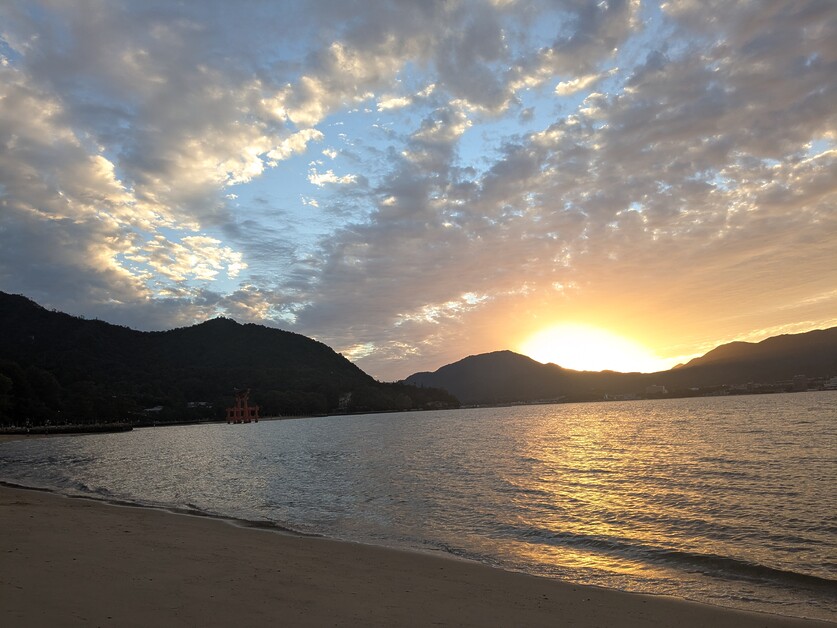
Staying overnight on the island at Kinsuikan meant I could experience Miyajima beyond its busiest sightseeing hours when the boats arrived. Next morning, I was able to return to the gate and watched the timeless scene of people praying beside the retreating waters.
Later my new guide, Tomoko Imada, helped me navigate the shrine’s customs. We purified our hands, then followed the sequence of bows and claps. The walkways and stage revealed a revered place shaped by ritual and the sea which it stands on.
Mount Misen
But soon we were heading up the 535-metre-high sacred Mount Misen, using the ‘cable car’ (known as the ropeway locally), which removes some of the strain, although there is still a proper uphill walk to the summit.
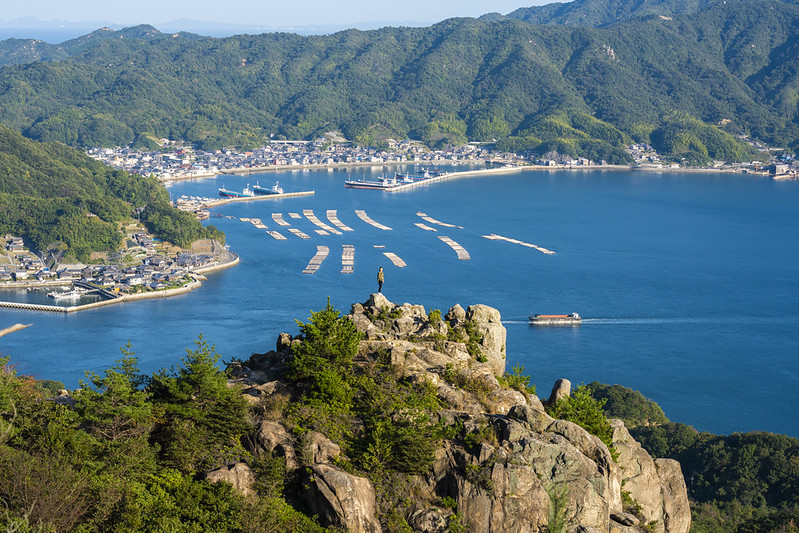
The view is well worth the effort providing a 360-degree vista of the Inland Sea, its islands and Hiroshima itself. And coming down, the huge queues for the cable car, proved that it’s always best to head up early in the morning.
Back in town we escaped the thronged main thoroughfare by turning into an older, much quieter street – just one row behind – and headed for a surprising lunch. This was a delicious Pakistani chicken curry with salad and an orange juice, eaten beside a small garden and served by a welcoming English-speaking owner. The bill was just 1350 yen, roughly £6.50 at around 210 yen to the pound.
That is the useful reality behind talk of Japan becoming affordable. Although exchange rates move, and elegant inns and private transfers still cost money. Everyday meals can provide excellent value, leaving room for something special in your budget. Oysters and anago meshi, conger eel over rice and other local temptations are worth seeking out.
Setoda on Ikuchijima Island
After another short ferry crossing, I was back on the mainland before a two-hour taxi transfer to Setoda, on Ikuchijima. This is the more leisurely face of the Hiroshima region, where an island town, lemon-growing and cycling gave my weekend another change of rhythm.
My base, Yubune, was a contemporary inn built around a community bathhouse on quaint Shiomachi Shopping Street, where cedar and tatami created a pleasingly restrained setting. More interestingly, it had no restaurant: guests are encouraged to eat in the surrounding neighbourhood, helping their spending reach local businesses.
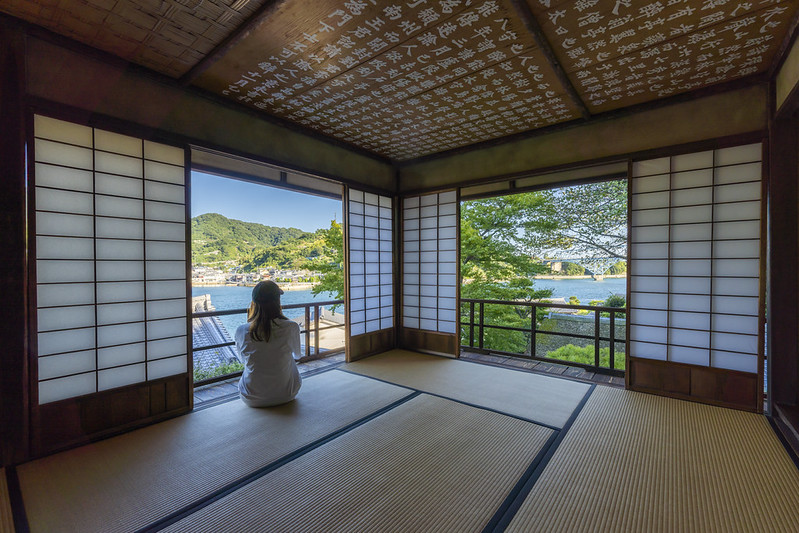
Next morning, after a very relaxing sleep, a traditional bath was followed by a walk to a nearby café for breakfast, where the waterfront provided a particularly civilised preparation for a day in the saddle. Rod Walters, a Bristol-born guide who has lived in Japan for decades, arrived to lead my ride. His fluent Japanese and easy conversation opened doors that a map alone could not.
The Shimanami Kaido
Our approximately 30-kilometre e-bike outing took me along Japan’s most famous cycle route, the Shimanami Kaido towards Onomichi. The full route runs for roughly 70 kilometres between Onomichi and Imabari, linking six islands across the Inland Sea and through spectacular landscapes.
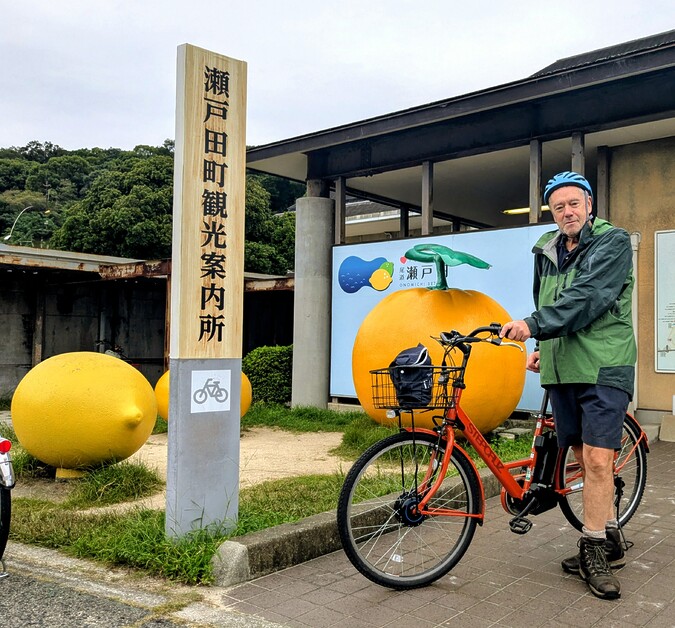
Thankfully, we did not opt to cycle that whole route in the unusually heavy rain which even slid down my legs and filled my leather boots. Unluckily, visibility was also limited, although the amazing bridges demanded my attention. I was glad I had arranged my luggage delivery in advance, as carrying everything on my back would have been a drenching nightmare.
Rod told stories of the Murakami seafarers, whose mastery of these waters gave them considerable influence. Commonly described as pirates, they also guided ships through difficult currents. His commentary turned the sea into a working historical landscape rather than merely a backdrop.
Onomichi
Onomichi itself provided a wonderfully individual finale. Its covered shopping streets contain an old knife shop, traditional businesses and a toyshop where I spotted a faded Monopoly box that looked several decades overdue for a new owner. Tea and cakes offered shelter from the rain turning these small discoveries into great memories.
By the time I changed into dry clothes and returned in a cab towards Hiroshima for a final night at the Hotel Granvia, where my suitcase and the Bullet Train to Fukuoka airport next morning awaited me, the weekend had taken me on an incredible journey from painful remembrance, to sacred architecture, island peace and (pretty damp but rewarding) physical effort.
What will stay with me, though, is that sleeping baby and smiling mum from my first morning as I came to understand that Hiroshima’s message reaches far beyond its monuments. I found it also in its people, buildings, sacred rituals, history, cooking, sports and the welcome it gives to strangers.
Images: James Ruddy and supplied
Tell Me More About This Insider Guide to Hiroshima And Its Region
There is plenty of online material to help you arrange a bespoke break in and around Hiroshima. These include hotels, ferries and guides. The Official Guide to Hiroshima: Find public transport maps, seasonal event info, and dining directories. Japan Guide: Hiroshima: Comprehensive overviews of historical sites, the Peace Park, and day trips. JNTO Hiroshima Complete Guide: Review transport options, local food (like okonomiyaki and oysters), and regional itineraries.
James sorted his weekend out after a Walk Japan 8-day trek through some of the off-the-beaten-track places of the San’In region.
Cathay Pacific operates indirect, one-stop flights to Japan via its main hub at Hong Kong International Airport.
For cut-price airport parking and hotels, try Holiday Extras: or call 0800 316 5678


